


Belmaco Archaeological Park


Belmaco Archaeological Park
Belmaco Archaeological Park (Carretera del Hoyo de Mazo, km 13.1, Mazo) — In the 17th century, the first petroglyphs discovered in the Canary Islands were found at Belmaco. The importance of these rock engravings made the site a reference point and obligatory visit for researchers interested in La Palma’s past, and in that of the archipelago. The archaeological complex is made up of ten natural habitation caves and a magnificent rock-engraving site. These caves were inhabited by the benahoaritas, the ancient settlers of Benahoare (the pre-Hispanic name of the island). In addition to the previously mentioned petroglyphs, in the Interpretation Centre, insight into the aborigine world is provided through models, photographic documents, multimedia facilities, and archaeological replicas, which illustrate and supplement the contents of the Park. Admission: €2 (adult), €0.75 (children). Hours: 10:00 am – 3:00 pm (Monday – Saturday) (closed on Sundays).
Calle O’Daly

Calle O’Daly
Calle O’Daly (Santa Cruz de la Palma) – this is one of the main commercial strips in not only the town of Santa Cruz, but the entire island. Unlike the more developed Canarian islands of Tenerife and Gran Canaria, there is a lack of major shopping malls in Palma island (most likely due to the island’s relatively small population). For that reason, major stores like Benetton and Mango (as well as other retailers) can be found on this street.
CAR RENTALS

CAR RENTALS
CAR RENTALS – the following car rental agencies operate in La Palma:
Autos Oasis: +34 922 43 44 09
Avis: +34 928 09 23 30
Cicar: +34 922 428 048
Europcar: +34 922 42 61 92
Hertz: +34 922 428 594
PlusCar: +34 928 827 055
Sixt: +34 871 18 01 92
Top Car Autoreisen: +34 661 39 61 69
Acropark

Acropark
Acropark (Hoya del Rehielo, Breña Baja) – this is an adventure park that is set within nature. Between the trees within the park, wooden platforms at different heights are all interconnected through steel cables, flying foxes, postmans bridges, swingbridges, rope ladders and nets.
The trees form trails that provide varying levels of difficulty to suit everyone’s abilities. Trails usually take between 40-90 minutes, depending on each person’s level of fitness. For those who enjoy nature and are after some fun outdoor activities, Acropark is the place to be. Hours: 10:00 am – 6:00 pm (Fridays to Sundays and public holidays only). See its website for more info including updated pricing: http://acropark.es
37 Grados Los Llanos

37 Grados Los Llanos (Edificio Tagomago, Los Llanos de Aridane) – located on the west end of the island, this is a popular rock club (complete with frequent live musical events). The patrons are age-diverse (at times attracting the 30-and-above crowd) – since bands are occasionally booked that play music from the 60s, 70s & 80s.
Bar Arepera El Encuentro

Bar Arepera El Encuentro
Bar Arepera El Encuentro (Calle Anselmo Pérez de Brito, 87, 38700 Santa Cruz de la Palma) – this eatery specializes in the popular Venezuelan snack food arepas (as well as other meals from that country, such as the ‘Enchapa’ — corn-maize pancake with fillings). This restaurant shows the island’s connection to Venezuela. There are two other “Bar Arepera” eateries at Avenida Marítima 22 and O’Daly 7 within Santa Cruz.
Ayuntamiento

Ayuntamiento
Ayuntamiento (Plaza España, Santa Cruz de la Palma) – located near one of the main streets of Santa Cruz (Calle O’Daly), this local government building is marveled by visitors, since it’s a fine representation of Renaissance era architecture on the island (rebuilt in 1559 during the reign of King Felipe II, after it was destroyed by French pirates). Free admission: Hours: 8:00 am – 3:00 pm (daily)(Sept. 16 – June 14); 8:00 am – 2:00 pm (daily)(June 15 – Sept. 15).
About La Palma
La Palma
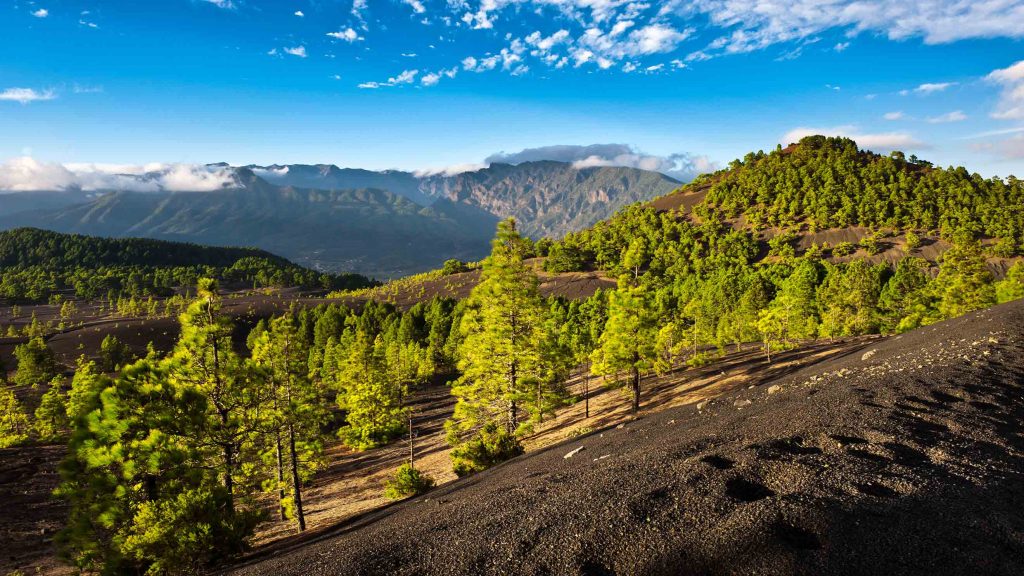
The volcanic island of La Palma is part of the Canary Islands (off the northwest coast of Africa). It’s the fifth largest of these islands, the furthest into the Atlantic Ocean, and a modestly-sizes population of just 86,000 residents. Like the rest of the Canary Islands, La Palma was settled by the Spaniards by the 15th century (the island reputedly named after one of the first conquistadors to have arrived there).
Spain’s domination over much of the Americas starting in the 16th century made the Canary Islands a vital stopping point for ships en route to that country’s colonies and other parts of the Americas. Sugar and other agricultural goods became staple products grown in La Palma and neighboring Canary Islands. The prosperity of the Canaries attracted famous pirates and corsairs of the time, particularly the French Jambe de Bois (Peg-Leg) who sacked the port city of Santa Cruz de La Palma in 1553. Most of the older buildings that can now be seen in Santa Cruz date from the subsequent rebuilding of the city. In 1585 Santa Cruz was attacked by an armada of 24 ships commanded by the English pirate Francis Drake, resulting in the destruction of the harbor fort.
From that point on, with Spanish rule over the Canary Islands uninterrupted throughout the centuries, La Palma’s economy survived on the production of various goods (in accordance to periodic market demands) – from wine to cotton, tobacco, silk, etc. Economic hardship during the latter part of the 19th century and the first half of the 20th century resulted in high levels of emigration — Cuba being the preferred destination up to the 1930s, and Venezuela afterwards. To this day, many Canarians retain strong family links with Cuba and Venezuela.
The Canarian economy continued to be dominated by agriculture until the early 1960s. Trade liberalization introduced by the Franco regime from 1960 onwards allowed an economic revival, based on bananas, annual exports of which exceed 130 million kilograms, plus other produce, forestry and tobacco. Most important of all was the growth of the tourist industry, from 73,240 tourists in 1960 to over 2 million tourists in 1975. To this day, tourism is a major part of the Canarian economy (including La Palma’s) – making up 32% of the islands’ GDP. The relative underdevelopment of La Palma island is an ideal destination for eco-tourists who are impressed with its natural beauty.


